




In recent years, Romania has become one of the most popular destinations for international students who want to Study Medicine in Romania. With medical programs taught in English and French, affordable tuition fees, and in many cases no entrance exam requirement, Romania is an excellent choice for building a successful medical career. By choosing to Study Medicine in Romania, you can also work across the European Union, as Romanian medical degrees are widely recognized across Europe.
In this article, we provide a complete guide to admission requirements for medical universities in Romania, the student visa process, the cost of studying and living, and an overview of the best medical universities in the country. If you’re looking to earn a reputable European medical degree with fewer barriers and a smooth application journey, continue reading.
Why Study Medicine in Romania?
International students looking to study in the European Union at an affordable cost can choose Romania as a smart destination for higher education. Medical universities in Romania are recognized by major international bodies such as the World Health Organization (WHO) and are aligned with European education standards.
In addition, many Romanian medical universities offer programs taught in English, making them accessible to students from all over the world. Annual tuition fees for studying medicine in Romania typically range from €8,000 to €10,000, which is significantly lower than the cost of medical education in many Western European countries.
In addition to its affordability, Romania has a robust healthcare education system that emphasizes practical skills and clinical exposure. Students benefit from modern facilities, experienced faculty, and opportunities to gain hands-on experience across various medical specialties.
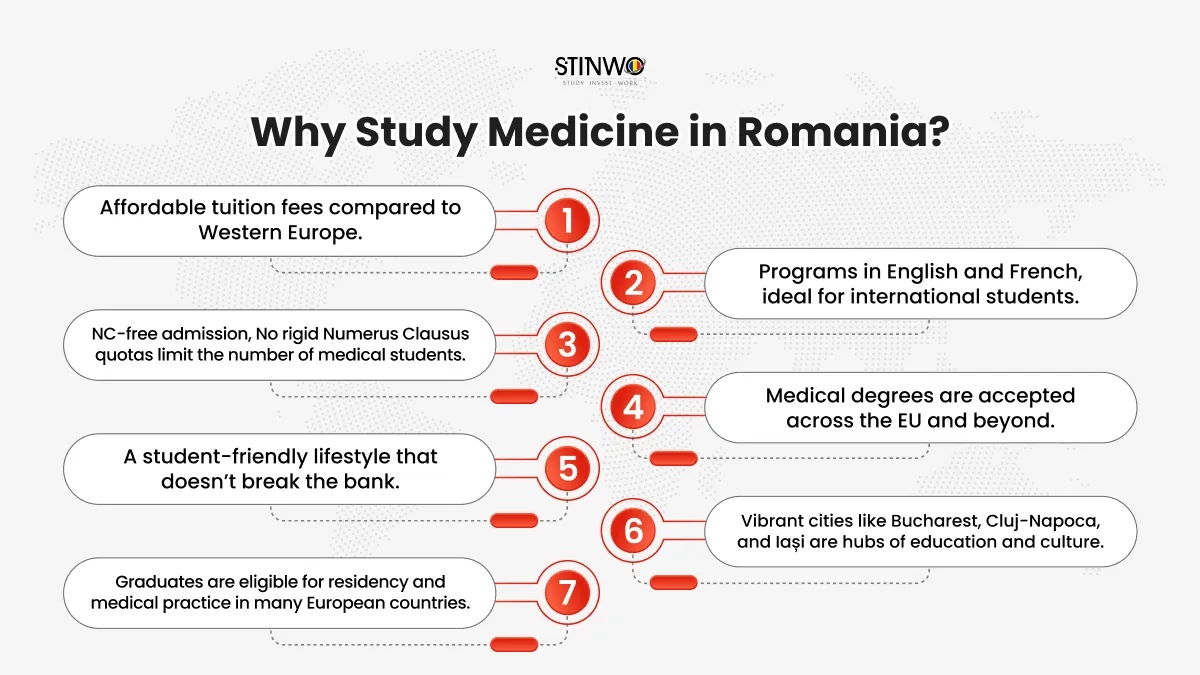
The peaceful environment and lower cost of living enhance the overall experience, making it a conducive place for students to concentrate on their studies. As a destination to study medicine in Romania, the country has established a strong reputation for delivering high-quality medical education at competitive costs. Here are some key reasons why students choose to study medicine in Romania:
- Affordable tuition fees compared to Western Europe.
- Programs in English and French, ideal for international students.
- NC-free admission, No rigid Numerus Clausus quotas limit the number of medical students.
- Medical degrees are accepted across the EU and beyond.
- A student-friendly lifestyle that doesn’t break the bank.
- Vibrant cities like Bucharest, Cluj-Napoca, and Iași are hubs of education and culture.
- Graduates are eligible for residency and medical practice in many European countries.
Romania’s unique combination of affordability and high educational standards makes it an increasingly popular choice for students worldwide. Besides, medical students can benefit from scholarships in Romania in order to decrease their cost of studying in Romania.
Benefits of NC-Free Medical Programs
Romania’s NC-free (Numerus Clausus-free) system means that universities are not limited by a strict quota on the number of students they can admit. The advantages of this system are as followed:
- Increased Opportunities: More students can pursue medical degrees.
- Flexible Admissions: Focus on academic performance rather than competitive exams.
- Diverse Classrooms: A welcoming environment for international students.
This approach fosters inclusivity and ensures that talented students have the opportunity to achieve their dreams of becoming medical professionals.
Study Medicine in Romania scholarship
Applicants who plan to Study in Romania should first explore the available funding options and scholarship opportunities. Scholarships are typically offered either by the Romanian government or directly by universities.
However, Romanian government scholarships usually do not cover Medicine, Dentistry, or Pharmacy. This means that if you’re aiming to study Medicine in Romania at the MD level or pursue residency training, government scholarships are generally not an option. The best chance of receiving financial support is through university merit-based scholarships, which are awarded to high-achieving students. In addition, student exchange opportunities through Erasmus+ may also include scholarship funding.
How to get scholarship to study Medicine in Romania
Most medical universities in Romania—such as Iuliu Hațieganu University of Medicine and Pharmacy (Cluj-Napoca), Grigore T. Popa University of Medicine and Pharmacy, and UMFST Târgu Mureș—offer scholarships for international students. These financial awards are typically granted based on semester GPA, academic ranking, research activities, or specific financial/medical circumstances.
Scholarships to Study Medicine in Romania can significantly reduce overall expenses for international students. Some Romanian universities that offer medical scholarships include:
- Cluj-Napoca University of Medicine and Pharmacy: Scholarships based on the academic performance of international students
- Iași University of Medicine: Scholarships available for medical studies starting from the 2023–2024 academic year
- George Emil Palade University: Scholarships that may cover not only tuition, but also accommodation and meals
These opportunities can be a major advantage for international applicants who want to Study Medicine in Romania at reputable European universities while keeping costs as low as possible.
How to study Medicine in Romania
To gain admission to a medical program in Romania, applicants must have a high school diploma (or equivalent). In most cases, you also need to achieve at least 50% in key subjects such as Biology and Chemistry. A stronger academic record generally increases your chances of acceptance.
If you want to Study Medicine in Romania in English, you’ll typically be required to provide a valid English language certificate such as IELTS or TOEFL, or take the university’s own language test.
Applicants should also pay close attention to application deadlines and document submission dates, as the timeline can vary from one Romanian medical university to another. Some universities may conduct an online interview to assess language ability and applicant motivation. In addition, students from non-EU countries must obtain a student visa for Romania to enter and study in the country.
Study Medicine in Romania requirements
To complete the application process for medical studies in Romania, several key documents are required:
- Passport: A valid passport is essential for identification and to facilitate the application process.
- Transcripts: Applicants must submit official transcripts from their previous educational institutions, detailing their academic performance.
- Motivation Letter: This letter should articulate the applicant’s reasons for choosing to study medicine, their career goals, and their motivation for studying in Romania.
- Medical Certificate: A health certificate is needed to confirm the applicant’s medical fitness for pursuing studies in the medical field.
These documents collectively help universities assess the qualifications and motivations of prospective students, ensuring a comprehensive evaluation of each application. For detailed information, students should consult the official websites of the universities they are interested in.
If you’d like more information about studying medicine in Romania, the best medical universities in Romania, or age limits for medical programs, you can get expert guidance from the international advisors at Stinwo. We’ll support you throughout the entire process—from choosing the right university and preparing your application to securing admission and completing the Romania student visa steps. To book a free consultation, simply fill out the consultation form on our website, and our team will contact you as soon as possible.
Study Medicine in Romania step-by-step Guide
To secure admission and Study Medicine in Romania, you need to follow a few clear steps. Completing each stage carefully helps ensure a faster, smoother, and error-free application process.
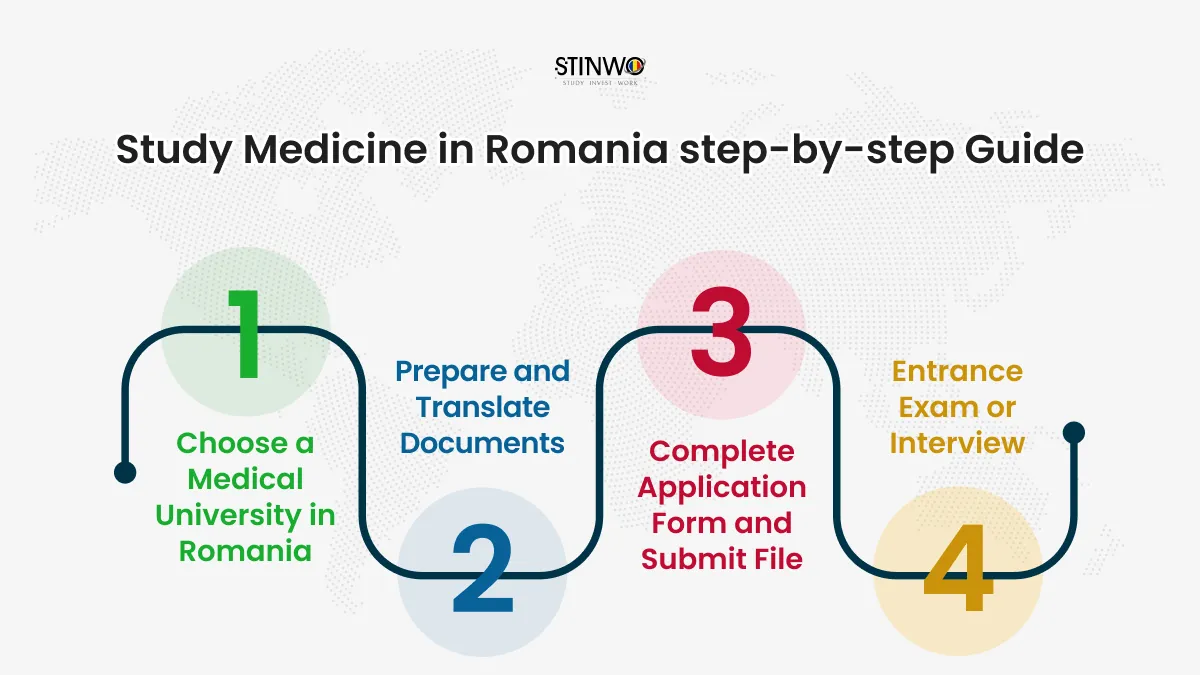
Step 1: Choose a Medical University in Romania
As the first step, you should select a reputable medical university in Romania. Carol Davila University, Grigore T. Popa University, Iuliu Hațieganu University, and Victor Babeș University are widely considered among the top medical universities in the country. After choosing your university, review its admission requirements, document submission deadlines, and the language of instruction.
Step 2: Prepare and Translate Your Documents
Gather the required documents, which typically include your high school diploma (and pre-university certificate if applicable), academic transcripts, passport, language certificate, motivation letter, and a personal photo. All documents must be officially translated into English or Romanian, depending on the university’s requirements.
Step 3: Complete the Application Form and Submit Your File
Once your documents are ready, complete the university’s application form and submit it along with the required paperwork. At this stage, you usually need to pay an application or file review fee as well.
Step 4: Take an Entrance Exam or Attend an Interview
Some medical universities in Romania assess applicants through an entrance exam or an interview. Along with strong English skills, solid preparation in Biology and Chemistry can significantly improve your chances of success.
Best university to study Medicine in Romania
If you’re planning to Study Medicine in Romania, choosing the right university is one of the most important steps. Romania is home to several respected medical institutions known for strong academic standards, modern clinical training, and international programs—often taught in English. Among the most recognized options are Carol Davila University of Medicine and Pharmacy (UMFCD) in Bucharest, Iuliu Hațieganu University of Medicine and Pharmacy in Cluj-Napoca (UMF Cluj), Grigore T. Popa University of Medicine and Pharmacy in Iași (UMF Iași), and Victor Babeș University of Medicine and Pharmacy in Timișoara (UMFT).
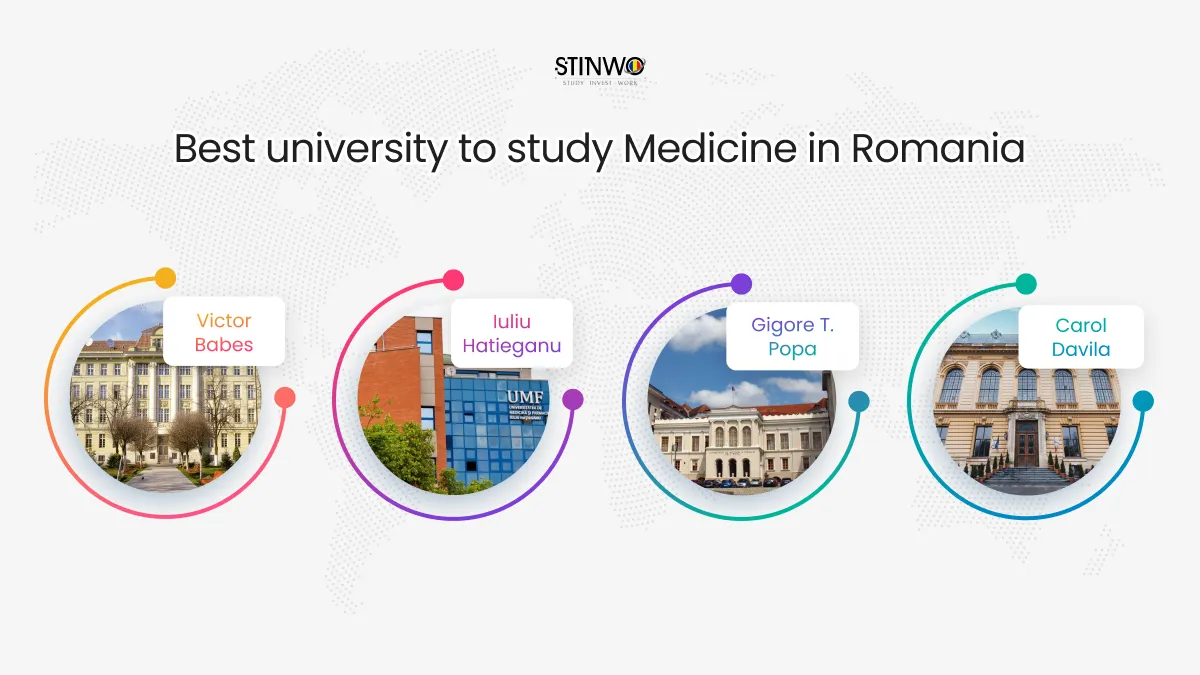
These universities are popular with international students because they combine reputable European medical education with practical hospital-based training and a supportive environment for foreigners. Each city also offers a distinct student experience, so the best choice depends on your preferred location, budget, and the university’s specific admission requirements and timeline.
Top medical universities in Romania
Romania is home to a number of internationally recognized institutions that make it possible to Study Medicine in Romania in English. Thanks to modern curricula, strong clinical training, and a growing international student community, these universities have become a popular choice for applicants who want a European medical education at a more affordable cost.
When it comes to the top medical universities in Romania, many offer full medicine programs taught in English, along with well-equipped teaching hospitals and experienced faculty. Choosing from the top medical universities in Romania can help you build a solid academic foundation and increase your opportunities for medical training and future career pathways across Europe.
|
University Name |
Language Options |
|
Carol Davila University of Medicine |
English, Romanian |
|
Iuliu Hațieganu University of Medicine |
English, French |
|
Grigore T. Popa University of Medicine |
English, French |
|
Victor Babeș University of Medicine |
English, French |
|
Ovidius University of Constanța |
English, Romanian |
These universities are recognized for their modern facilities, experienced faculty, and welcoming international environments. They attract students from across the globe, fostering a diverse and multicultural classroom experience.
As we delve deeper, we will provide more information about medical universities in Romania, covering their programs, admission processes, and the many advantages of choosing to study medicine in Romania.
Carol Davila University of Medicine and Pharmacy (Bucharest)
Located in the capital city, Bucharest, Carol Davila University of Medicine and Pharmacy is widely regarded as one of the top medical universities in Romania. Founded in 1869, it is known for its long-standing contribution to the development of healthcare and medical education in the country. The university offers programs in Medicine, Dentistry, and Pharmacy, with study options available in English and Romanian—making it a strong choice for international applicants who want to Study Medicine in Romania.
The Medicine program is 6 years long and provides access to modern teaching and hospital facilities. According to the information provided, the annual tuition fee typically ranges from €8,500 to €10,000, which is often considered more affordable compared to many Western European medical schools.
Iuliu Hațieganu University of Medicine and Pharmacy (Cluj-Napoca)
Another excellent option among the top medical universities in Romania is Iuliu Hațieganu University of Medicine and Pharmacy, established in 1919 in the student-friendly city of Cluj-Napoca. It is recognized for advanced facilities, comprehensive academic programs, and its impact within the broader medical community. For international students planning to Study Medicine in Romania, this university stands out due to its strong academic structure and well-developed clinical training approach.
The Medicine program lasts 6 years and is offered in Romanian, English, and French. The curriculum is designed to combine theoretical knowledge with hands-on clinical learning, helping students build essential medical skills in a practical environment. The tuition fee for Medicine is listed as €10,000 per year.
Grigore T. Popa University of Medicine and Pharmacy (Iași)
Founded in 1879, Grigore T. Popa University of Medicine and Pharmacy in Iași is a respected institution and a solid choice for those who want to Study Medicine in Romania. The Medicine program is available in English and Romanian, providing flexible study options for international students and a supportive learning environment.
Based on the latest provided figures for the 2026–2027 academic year, the annual tuition fee is €9,000. The Medicine program is 6 years long, with a strong focus throughout the degree on both medical theory and clinical skills development.
Victor Babeș University of Medicine and Pharmacy (Timișoara)
Victor Babeș University of Medicine and Pharmacy in Timișoara is known for its innovative approach to medical education and its commitment to medical research. Established in 1945, it has grown into one of the top medical universities in Romania, offering Medicine, Dentistry, and Pharmacy programs with international pathways for students aiming to Study Medicine in Romania.
Students can study in Romanian, English, or French, depending on the chosen program. The most recent tuition figure provided is €9,000 per year. The Medicine degree is 6 years and emphasizes both theoretical learning and practical training to prepare students for clinical work and future medical careers.
Study Medicine in Romania for international students
When you Study Medicine in Romania, you’ll typically follow a 6-year integrated medical program worth 360 ECTS credits. This integrated cycle combines undergraduate and master-level medical education into one continuous pathway, and graduates receive an MD (Doctor of Medicine)—often referred to as a professional medical doctorate. For many applicants, Study Medicine in Romania for international students is an attractive option because the structure is clear, standardized, and aligned with European higher education frameworks.
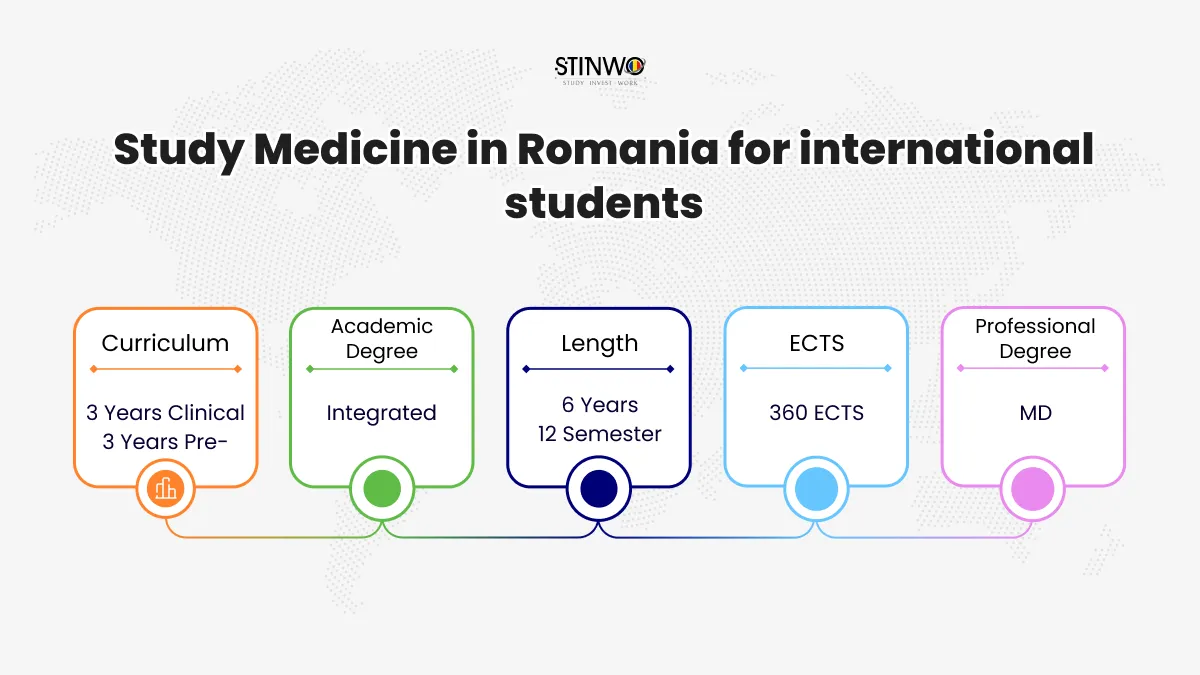
The curriculum is usually divided into two main phases. The first three years focus on pre-clinical training, covering core subjects such as Anatomy, Physiology, Biochemistry, Pathology, and Microbiology. From year four, students move into the clinical phase (three years), where learning becomes practical through hospital and clinic rotations. During these clinical years, students complete hands-on training in major specialties such as Internal Medicine, Surgery, Pediatrics, Obstetrics & Gynecology, Psychiatry, and Emergency Medicine.
Apply to study Medicine in Romania
In most cases, the main application window to Apply to study Medicine in Romania opens in early May and runs through June, with many universities accepting applications until late July for the first intake. Some institutions may also offer an additional September window if places are still available.
If you’re a non-EU applicant planning to Study Medicine in Romania, it’s strongly recommended to apply in the first intake whenever possible. Applying early gives you enough time to receive your acceptance letter and complete the student visa process without last-minute pressure.
|
University |
Application Deadline (Example Intake) |
| Iuliu Hațieganu University of Medicine and Pharmacy |
28 May 2025 |
|
Carol Davila University of Medicine and Pharmacy |
11 July 2025 |
| Grigore T. Popa University |
March 1st – May 1st 2026 |
|
Victor Babeș University of Medicine and Pharmacy |
22 July 2025 |
| Transilvania University of Brașov |
11 July 2025 |
Deadlines can change from year to year, and each university may update its calendar based on available seats and administrative timelines. To Apply to study Medicine in Romania successfully, make sure you check the latest intake dates on the university’s official website and prepare your documents early—especially if you plan to Study Medicine in Romania as a non-EU student and need extra time for visa processing.
How to become a doctor in Romania
Medical education in Romania is available in Romanian, English, or French and follows a structured pathway that combines pre-clinical and clinical training. If you’re researching How to become a doctor in Romania, it helps to understand the full journey—from admission to graduation and, if desired, residency specialization.
- Admission and arrival: Choose your university and language of instruction, prepare the required documents, submit your application, and—if you are a non-EU applicant—obtain a Romanian student visa.
- Medical studies (6 years): Complete three years of pre-clinical training in core medical sciences, followed by three years of clinical education and hospital-based internships.
- Graduation and specialization: Sit the final exams, receive your M.D. degree, and if you choose, continue into a residency program to specialize.
For non-EU graduates who want to work as doctors in Romania, there are additional licensing steps after graduation. You must first have your medical degree recognized through CNRED, then register with the Romanian College of Physicians (CMR) and submit the required documentation. Romanian language proficiency is typically mandatory for clinical practice, and you may need to provide an official language certificate. Once CNRED recognition and CMR registration are approved, you can receive authorization to practice medicine in Romania.
Study Medicine in Romania fees
For most medical universities, the study medicine in Romania tuition fee typically ranges from €7,500 to €10,000 per year, which is why many applicants view study medicine in Romania fees as a more affordable route to a European medical degree compared with many Western European destinations; if you’re comparing study medicine in Romania in English fees, you’ll usually find that English-taught Medicine programs fall within the same annual range, although the exact amount can vary by university, city, and program structure.

Beyond tuition, you should also plan for study medicine in Romania for international students fees related to everyday living, which average around €500 to €800 per month and generally cover essentials such as accommodation, food, and transportation—meaning that when you calculate both tuition and living costs together, the total study medicine in Romania fees remain manageable for many international students who want quality medical education in the EU without an extremely high overall budget.
Study Medicine in Romania Without Entrance Exams
One of the key attractions for international students is Romania’s flexible admission process, which facilitates a smoother journey for those looking to study medicine in Romania. Many universities do not require entrance exams, opting instead to evaluate candidates based on their high school or bachelor’s grades, particularly in relevant subjects like Biology and Chemistry. This method makes the application process straightforward for qualified candidates.
Additionally, proficiency in the language of instruction—either English or French—is essential, often necessitating certification. By eliminating the pressure of competitive exams, this approach allows students to concentrate on fulfilling academic and language requirements. This flexibility broadens opportunities for a wider range of candidates who may excel academically yet struggle with high-pressure exam situations, making it easier for them to study medicine in Romania successfully.
Admission Process for Medical Studies in Romania
The admission process for medical universities in Romania is designed to attract a diverse range of international students.
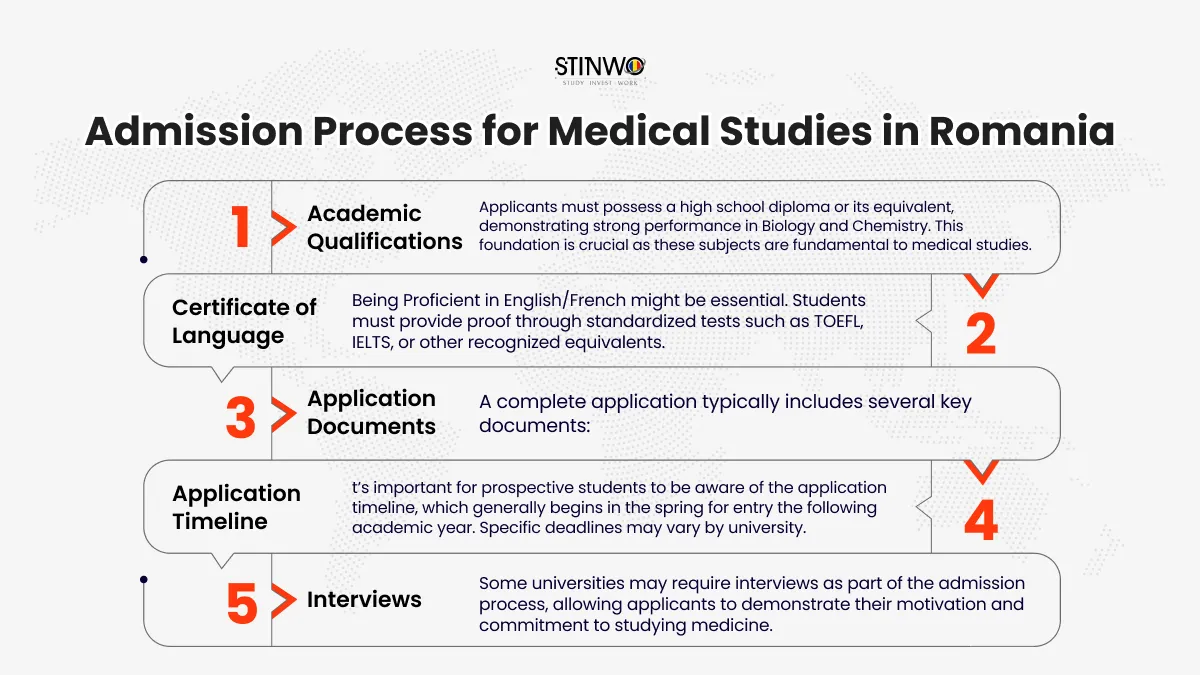
The general requirements are as follows:
- Academic Qualifications: Applicants must possess a high school diploma or its equivalent, demonstrating strong performance in Biology and Chemistry. This foundation is crucial as these subjects are fundamental to medical studies.
- Certificate of Language: Being Proficient in English/French might be essential. Students must provide proof through standardized tests such as TOEFL, IELTS, or other recognized equivalents.
- Application Documents: A complete application typically includes several key documents:
- Application Timeline: It’s important for prospective students to be aware of the application timeline, which generally begins in the spring for entry the following academic year. Specific deadlines may vary by university.
- Interviews: Some universities may require interviews as part of the admission process, allowing applicants to demonstrate their motivation and commitment to studying medicine.
This structured process ensures that only qualified candidates are admitted, maintaining the high standards of medical education in Romania. For more detailed information about specific universities’ requirements and deadlines, applicants should visit the official university websites.