
Romania inflation concerns will likely stay at the top of many households’ priorities as the country heads into 2026, according to a survey by the Romanian Institute for Evaluation and Strategy (IRES). Beyond rising prices and day-to-day expenses, respondents also highlighted uncertainty around both domestic and international politics, suggesting that personal finances and a sense of wider stability are closely connected in shaping expectations for the year ahead.
Still, the findings aren’t entirely gloomy. A meaningful share of respondents believe 2026 will be better than 2025 at a personal level, and the “top needs” Romanians cite—health, financial stability, and social cohesion—also highlight where solutions and progress can make the biggest difference.
Inflation and Cost of Living: Why They Matter Most
When people talk about inflation, they’re usually describing a simple reality: the same income buys less. The cost of living captures that daily experience—groceries, energy bills, rent, transportation, and essentials shifting upward while many families try to keep pace.
The IRES results place Romania inflation concerns among the country’s most pressing issues heading into 2026, reflecting how strongly price changes affect confidence and planning. Even when national indicators improve, households often judge the economy by what happens at checkout counters and on utility bills.
When inflation becomes a top concern, it often pushes stronger public pressure for clearer economic policies—like targeted support, wage discussions, and anti-corruption measures that can reduce waste and improve delivery of public services.
Politics at Home and Abroad: A Major Source of Anxiety
The survey shows that politics weighs heavily on people’s expectations:
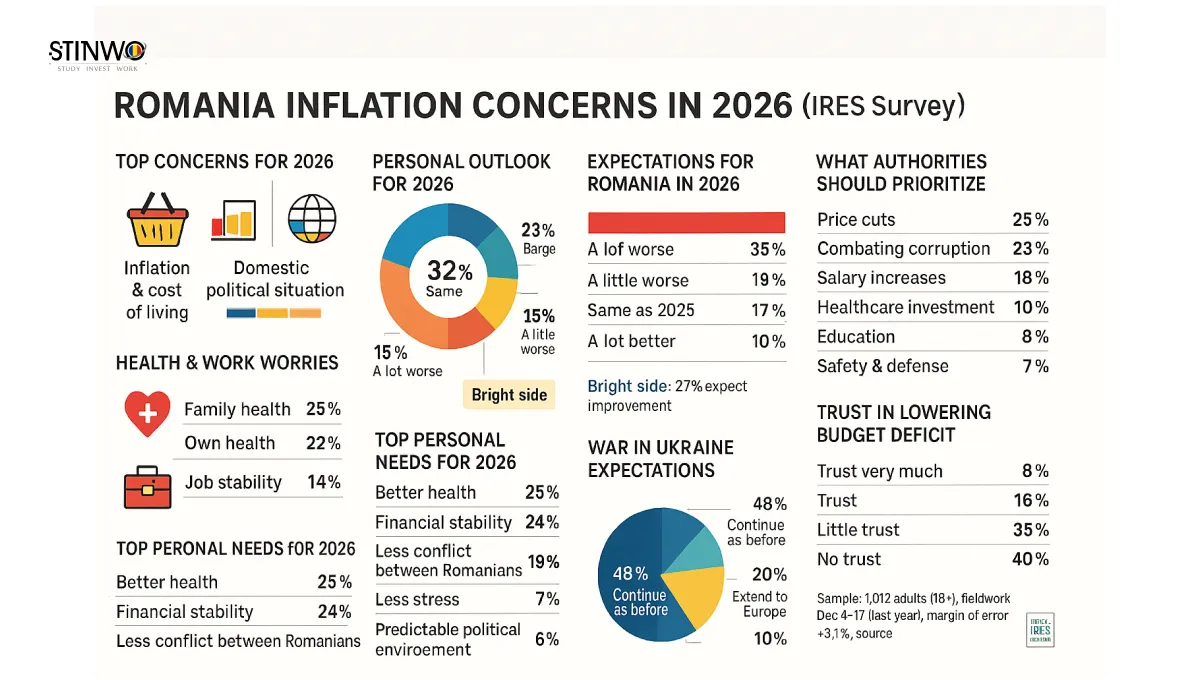
- Domestic political situation: 31% are concerned “to a very large extent,” and 28% “to a large extent.”
- International political context: 26% are concerned “to a very large extent,” and 29% “to a large extent.”
Romania inflation concerns suggest many Romanians are not only watching prices but also the stability that influences them—government decisions, regional security, and external shocks. High public attention can be a catalyst for accountability, and Romania inflation concerns also highlight why political predictability matters: when citizens clearly name it as a need, leaders have stronger incentives to communicate plans, reduce uncertainty, and focus on pragmatic priorities.
Personal Outlook for 2026: Not All Expectations Are Negative
Asked how 2026 will look personally, responses were mixed:
- 16% think it will be “a lot better”
- 23% think it will be “a little better”
- 32% expect it to be the same as 2025
- 15% anticipate “a little worse”
- 13% anticipate “a lot worse”
That means a sizeable group—nearly four in ten—see improvement ahead, and about a third expect stability rather than decline. Stability matters. In uncertain times, expecting “the same” can be a form of cautious optimism—especially for households that prioritize predictability over sudden changes.
Health and Job Stability: Core Household Priorities
Beyond economics and politics, Romanians also reported strong concerns around health:
- Family health: 26% concerned “to a very large extent,” 28% “to a large extent”
- Own health: 22% concerned “to a very large extent,” 27% “to a large extent”
- Job stability: 14% “to a very large extent,” 17% “to a large extent”
These results reinforce that quality of life is multidimensional—people may worry about prices, but health and steady work remain central to how secure they feel, reflecting broader Romania inflation concerns as well. The clear emphasis on health can strengthen the case for better prevention, access, and investment—especially when citizens consistently rank healthcare improvements as a national priority.
What Romanians Say They Need Most in 2026
When asked about the top personal need for 2026, respondents prioritized:
- Better health (25%)
- Financial stability (24%)
- Less conflict between Romanians (19%)
- Less stress (7%)
- A more predictable political environment (6%)
- More free time (5%)
Smaller shares mentioned exercise, stable relationships, and learning/personal development. This ranking is revealing: Romanians aren’t only asking for higher incomes. They’re also asking for a calmer social climate and a more manageable day-to-day life. “Less conflict” appearing near the top is a hopeful signal. It suggests people value social cohesion and may support initiatives that bring communities together—locally and nationally.
What People Want Authorities to Focus On in 2026
Respondents named clear priorities for government:
- Price cuts (25%)
- Combating corruption (23%)
- Salary increases (18%)
- Investments in healthcare (10%)
- Improving education (8%)
- Safety and defense (7%)
Other themes included electoral system consolidation, international relations, road infrastructure, digitalization of public administration, and migration/demography (each at 2% or below). This is essentially a public roadmap: ease pressure on households, improve governance, and invest in long-term systems like healthcare and education.
These priorities are actionable. They point toward concrete policy levers—better procurement, more transparent spending, smarter public investment, and reforms that improve everyday outcomes.
Expectations for Romania as a Country: Cautious and Concerned
Looking at 2026 for Romania country, respondents leaned more pessimistic:
- 35% expect 2026 to be “a lot worse”
- 19% expect “a little worse”
- 10% expect “a lot better”
- 17% expect “slightly better”
This gap—more optimism personally than nationally—often shows up in surveys. People may believe they can manage their own circumstances, even if they doubt national direction. Even here, more than a quarter expect improvement. That group represents a base of confidence that can grow if policy outcomes align with public priorities.
On whether the government can lower the budget deficit in the next two years:
- 8% trust this “very much”
- 16% trust it somewhat
- 35% have little trust
- 40% have no trust
This indicates a major credibility gap—especially important because deficit management affects inflation expectations, public spending, and long-term stability, shaping Romania inflation concerns and the cost of living in Romania. When trust is low, communication and measurable progress matter more than slogans, and Romania inflation concerns tend to intensify. Clear milestones, transparent reporting, and visible anti-waste measures can improve confidence over time.
War in Ukraine: What Romanians Expect
When asked about the war in Ukraine:
- 48% expect it to continue as before
- 20% think it could extend to Europe
- 15% expect it to end with Russia obtaining everything it demands
- 10% expect the war will end favorably for Ukraine
This mix shows uncertainty, with many anticipating a prolonged status quo—an outlook that can also shape broader Romania inflation concerns. The largest group expects continuity rather than immediate escalation, suggesting people may be bracing for ongoing uncertainty—but not necessarily expecting the worst-case scenario as the most likely outcome.
The survey was conducted on a representative sample of 1,012 respondents aged 18+, between December 4 and December 17 of the previous year. The reported error margin is ±3.1%.
Conclusion: Concern, Yes—But Also Clear Priorities and Room for Progress
The IRES findings confirm that Romania inflation concerns and the cost of living dominate the public mood for 2026, reinforced by anxiety about political stability and broader geopolitical uncertainty. At the same time, the survey highlights something constructive: many Romanians still expect their personal lives to improve or remain stable, and they’re remarkably consistent about what would help most—better health, financial stability, less conflict, and practical government action on prices, corruption, wages, and public services. In other words, the challenges are real—but so is the roadmap. If decision-makers focus on the areas people care about most, 2026 could bring not only fewer worries, but more confidence.
Resource: Romania-Insider